Adopt
One-month PoC
For one month, Kitewell runs the work or integration you choose on the same screens and data as production, measured against success criteria agreed up front. If it does not meet them, you are not charged.
What the PoC proves
After the demo and the connection test, you choose the work or integration to test. The PoC shows whether Kitewell holds up in daily operation, on production screens and data.
- Which method connects each target system: API, file, database, or screen
- Whether Kitewell can work a system with no API through its screens, as a person would
- Whether AI relearns a step and processing continues when a screen changes
- Whether errors are handled as agreed: stop, notify, or retry
- Whether it runs in your environment, with the AI model you choose
- Whether processing time and AI usage cost fit daily operation
How it runs
One month, in four stages.
Week 1
Requirements and success criteria
Agree on the data, what starts each run, the volumes, and how errors are handled, and set the success criteria in numbers. Where it runs, which AI model it uses, and who builds the workflows (your team, an SIer partner, or Descarty's support) are settled here too.
Weeks 2 to 3
Build
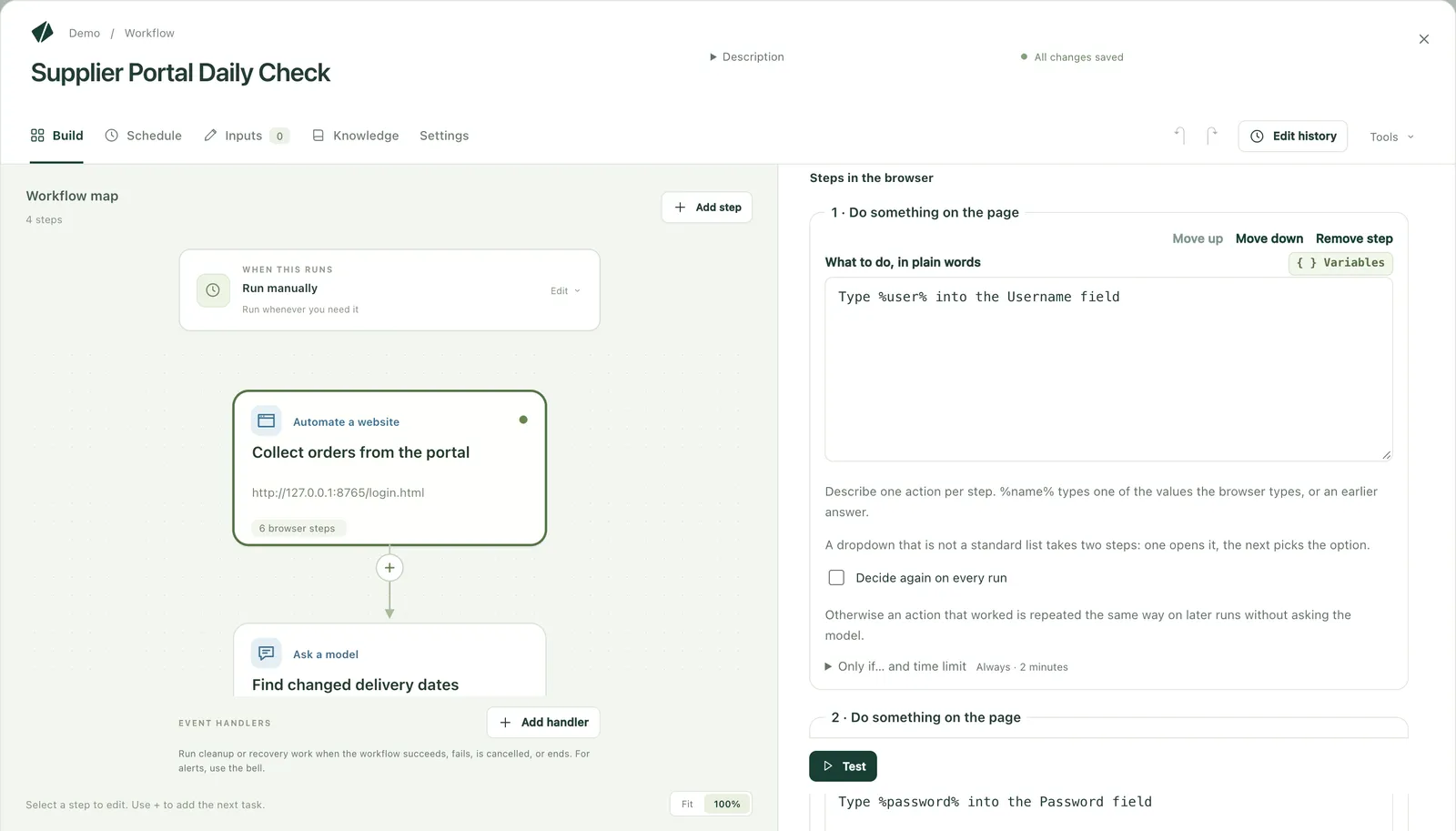
Describe the steps of the work in plain words, and Kitewell builds the workflow. The connections, through APIs, files, databases, or screens, are put together in an environment that matches production.
Week 4
Verify on production screens
It runs on the same screens and data as production, including when errors occur and when part of a screen changes. Every run is recorded with screenshots, so each result can be checked afterwards.
Final day
Report
The results against each success criterion, processing time, success rate, why runs stopped and how they were handled, and the estimated effect, reported with a proposed production setup.
Example success criteria
The success criteria are agreed with you in week 1.
- The time the work takes falls by at least the agreed share
- The agreed volume is processed by the agreed time
- Processing continues without rewriting the workflow when part of a screen changes
- Your own staff can change a step by describing the change in plain words
- AI usage cost stays within the agreed limit
What you keep at the end
Workflows stay with you as YAML files, ready to carry into the production build.
- Business flow diagrams: the work as it runs today, and as it runs automated
- The workflows the PoC ran, as YAML files, with their knowledge
- A robot ledger listing every workflow
- A verification report: results against each criterion, processing time, success rate, why runs stopped and how they were handled, and the estimated effect
- A proposed production setup: where it runs, how many computers, and which AI model
Cost and terms
What you pay depends on whether the agreed success criteria are met.
- Length
- One month
- Cost
- ¥500,000 (tax excluded)
- If the criteria are not met
- Not charged
- If you go on to a license
- The PoC fee is credited to the first year's contract
- Who builds the workflows
- Your team, an SIer partner, or Descarty's support
- Support after the PoC
- Optional support from Descarty or a partner for the production build and maintenance
Starting a PoC
After a demo, and a connection test where it helps, the scope and success criteria are set together and the PoC begins.
You can also check only whether your systems connect first. Request a free connection test
What to have ready
- Test accounts and access to the target systems: screens, APIs, files, or databases
- Sample data close to production
- A computer to run Kitewell: an on-premises server, a PC, a VM, or your cloud
- Access to the AI model you will use, such as Azure OpenAI, Amazon Bedrock, Google Vertex AI, or an in-house model
The results are published as a case only with your consent, and can leave your company's name out.
Frequently asked questions
- Can we check only whether our systems connect before a PoC?
- Yes. A connection test checks whether each target system connects through an API, files, a database, or its screens, using a test environment or a recording of the work with sample data. It costs nothing.
- Who builds the workflows in the PoC?
- Your own team, an SIer partner, or Descarty's support; it is decided in week 1. Either way, Kitewell builds each workflow from the steps of the work described in plain words.
- Can the workflows built in the PoC go into production?
- Yes. They stay with you as YAML files and carry straight into the production build.
- Where does the PoC run?
- In the environment you plan to use in production: on-premises servers, PCs, VMs, a closed network, or your own Azure, AWS, or Google Cloud. Run records, results, and credentials are stored on the computer that runs Kitewell.
- Which AI model does it use, and is our data used for training?
- The model you choose: Azure OpenAI, Amazon Bedrock, Google Vertex AI, or an in-house model that speaks the OpenAI API. Under their terms, Azure OpenAI, Amazon Bedrock, and Google Vertex AI do not use what you send for training by default. With an in-house model, data is not sent outside.
- Do we have to replace all of our RPA?
- No. Move the work that breaks often and matters most first, and leave work RPA handles well, such as fixed operations replayed at high speed, where it is.
- Who is the contracting party, and in which languages do you work?
- Your contract is with Descarty, Inc., headquartered in Tokyo. We work in Japanese and English.
Start a PoC on your own systems
Tell us about the target systems, the work, and where things stand today. We usually reply the same business day.